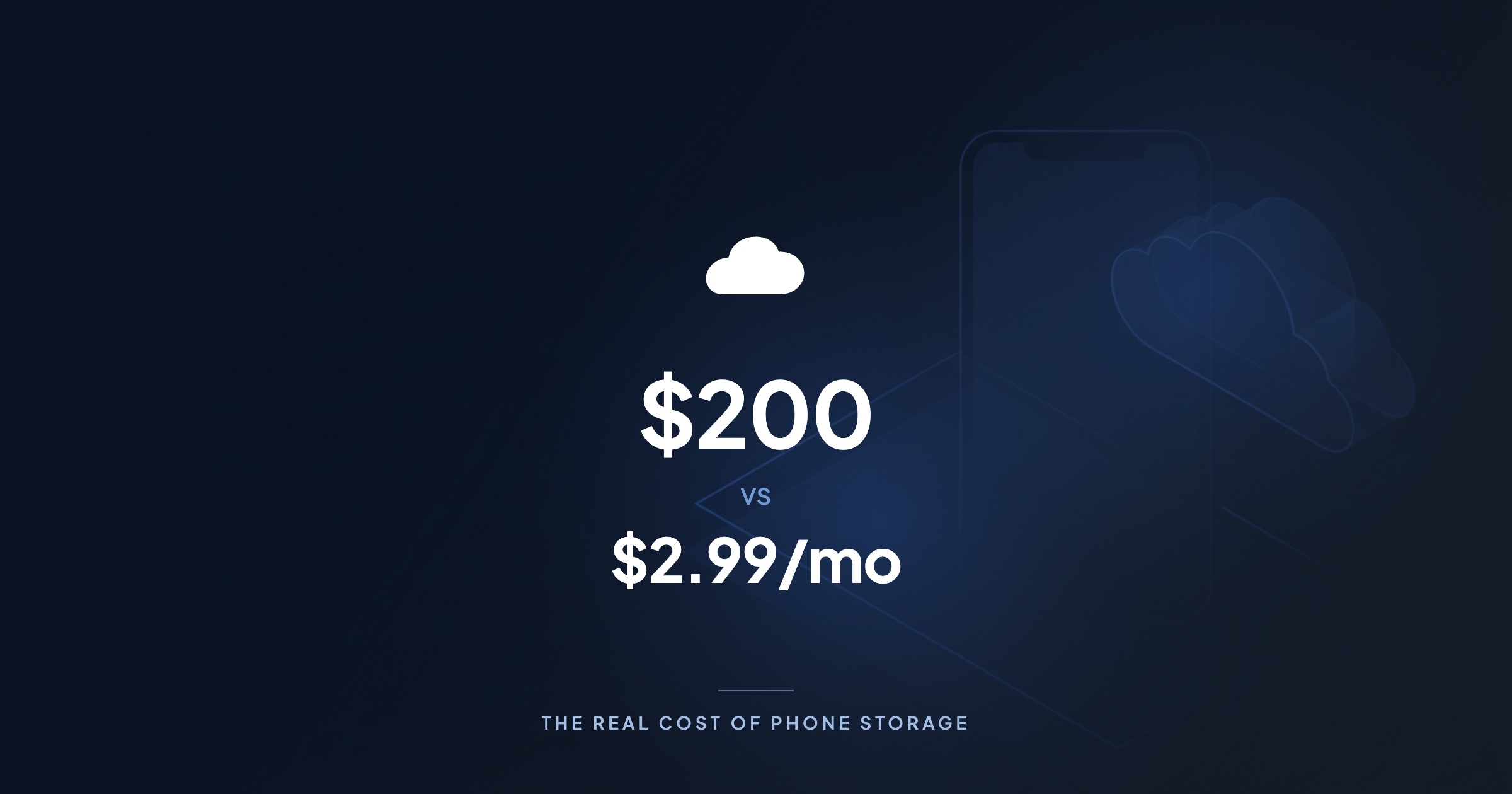
Every two or three years, you face the same choice: 128GB or 256GB? It feels like a small decision at checkout, so you pay the extra $200 and move on. But over time, that decision adds up to something much bigger than most people realize.
The storage tax at checkout
When Apple sells you an iPhone 16 with 256GB instead of 128GB, the price jumps from $699 to $899. That’s $200 for 128 additional gigabytes of local storage.
Here’s what $200 buys you in cloud storage instead:
- Google One: 200GB for $2.99/month — that $200 covers over 5.5 years
- iCloud+: 200GB for $2.99/month — same math, same result
- 2TB plans: $9.99/month — $200 still covers 20 months of storage that’s 16x larger
The phone upgrade gives you 128GB that lives on one device, can’t be shared, and disappears when you switch phones. The cloud option gives you more storage, accessible from any device, for a fraction of the cost over time.
The family math is worse
Most families don’t have one phone. They have three, four, sometimes five. And the storage upgrade decision multiplies with each one.
A family of four, each choosing the 256GB iPhone 16 over the 128GB:
- Phone storage upgrades: $200 × 4 = $800
- Every upgrade cycle (2–3 years): another $800
- Over 6 years (two upgrade cycles): $1,600 spent on storage alone
Compare that to a shared cloud plan:
- 200GB shared plan: $2.99/month × 72 months = $215 total over 6 years
- 2TB shared plan: $9.99/month × 72 months = $719 total over 6 years — and that’s 2 terabytes
The difference isn’t subtle. A family can save between $880 and $1,385 over six years by choosing the base phone and backing up to the cloud.
Why we keep paying it
Phone manufacturers have learned that storage anxiety converts. When you see “Storage Almost Full” on your phone, the easiest fix feels like buying a bigger phone next time. The notification isn’t a helpful reminder — it’s a sales funnel for future upgrades.
Cloud storage breaks this cycle. Your photos move off the device. Your phone stays fast. And the next time you upgrade, you buy the base model, transfer your photos from the cloud, and move on. No re-purchasing storage you already had.
What matters beyond the math
Cost is one part of this equation. There are others:
- Durability: A lost or broken phone means lost photos if they’re only stored locally. Cloud backup means your memories survive the device.
- Access: Photos stored on one phone are trapped on one phone. Cloud storage makes them available on any device, any time.
- Flexibility: You’re not locked into one manufacturer’s ecosystem. Your photos can move with you.
These aren’t hypothetical benefits. They’re the practical reality of decoupling your memories from your hardware.
What we’re building
Abrio is cloud storage designed for exactly this problem. Affordable backup for your photos and videos, without the markup of a phone storage tier and without the privacy trade-offs of services that mine your data.
We think your memories deserve a better deal than a $200 checkout upsell.
Join the waitlist
Be among the first to experience Abrio when we launch.
By signing up, you agree to our Terms and Privacy Policy — both written to be read.